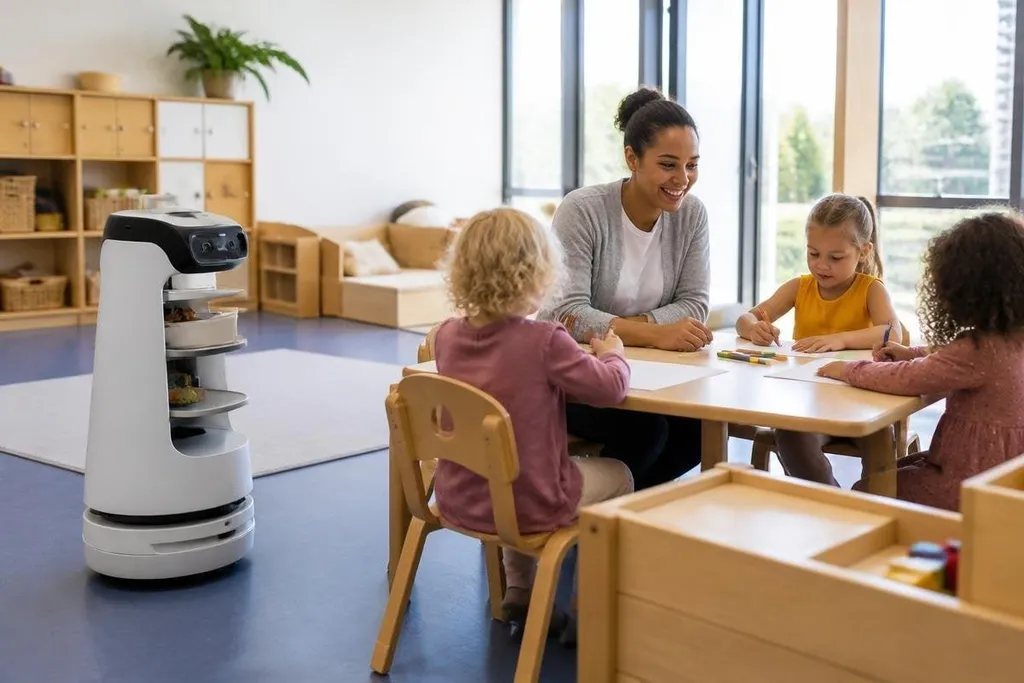
A childcare robot does not need to watch a child alone to become a business. The nearer opportunity may be a machine that helps staff with learning activities, room checks, or routine work while an adult stays responsible.
That distinction changes who buys the robot, what the robot must do, and how a company gets paid. For a founder or childcare operator, the safer question is: which task can a robot handle without asking families to accept a machine as a caregiver?
- Lower-risk work: Support teaching, movement, or room routines while staff stay present.
- Clear buyers: Sell to childcare centers, therapy providers, or families with a defined need.
- Hard proof: Show safe behavior, useful results, and a clear plan for faults.
Where the business could start
Childcare centers have repeated tasks that do not require a robot to make decisions about a child’s welfare. A mobile robot could carry books or supplies between rooms. A small social robot could lead a guided song, language exercise, or turn-taking game under adult supervision.
Those uses still need careful product design. The robot must stop when a child enters its path, keep its moving parts away from small hands, and let a staff member stop it at once. A business case built around one narrow task is easier to test than a promise to manage an entire room.
Families may also pay for home robots that support practice between adult-led activities. Examples could include guided reading, speech exercises, or simple games that reward a child for taking turns. The machine should support a parent or therapist’s plan, not make its own claims about a child’s health or development.
The buyers are different
A center may pay for a robot through an equipment budget and need staff training, cleaning instructions, repairs, and a service plan. A family may care more about setup time, noise, privacy, and the cost of replacing a damaged part.
Therapy providers bring another set of needs. They may ask for records that show what activity ran, how long it lasted, and when an adult stepped in. A vendor that stores those records must explain where they go, who can see them, and how a family can delete them.
These details create several ways to sell the product. A company could charge for the robot itself, rent it with maintenance, or sell a software plan for new activities.
Each model changes the buyer’s risk, so the contract must state what the robot does and what staff must do.
A childcare buyer needs to compare the robot’s task, staff role, price, and test record before signing a contract. Robot24.com can place those details beside other automation systems, so the buyer can see which claims affect daily care and which limits belong in the safety plan.
Safety is part of the product
Childcare adds limits that do not apply to a robot in an empty office. A camera may record faces. A speaker may repeat a child’s name. A moving base may reach a child’s foot before a staff member can react.
A company needs a clear answer for each case. It should explain what sensors the robot uses, what happens when a sensor fails, and whether the robot can work without recording video or audio.
It should also show how an adult takes control during a fault.
The hardest business question may be liability. If a child trips near the robot, the center and vendor will need to know who inspected the area, who approved the robot’s movement, and what the machine recorded. A product that cannot answer those questions may spend more time in review than in use.
What remains unproven
A demonstration can show that a robot speaks, moves, or recognizes an object. It does not show that children will use it safely over months, that staff will keep using it after training, or that the cost fits a center’s budget.
The missing evidence should shape the first sale. A pilot could measure staff time, child participation, unplanned stops, repair calls, and adult interventions. Those records would give a buyer something firmer than a short video.
I'd put the first serious investment into supervised tools for staff, not a robot marketed as a substitute caregiver. The task is narrower, the safety case is easier to inspect, and the buyer can judge the result without handing over responsibility for a child.
A buyer’s checklist
Before signing a pilot or purchase order, ask:
- Name the task: Define the repeated job and set a measure for staff time or completed activities.
- Set adult control: Can a staff member stop movement, sound, and data collection at once?
- Check the data: Does the robot record children, and can the center remove those records?
- Price the full service: Include training, repairs, software, cleaning, and replacement parts.
- Plan the fault: What happens when a sensor, network link, battery, or motor stops working?
A childcare robot has a business case when it removes a defined burden without creating a larger safety or trust problem. The next useful proof is not a brighter demo. It is a supervised pilot with measured staff time, intervention counts, and a cost that a real center can carry.